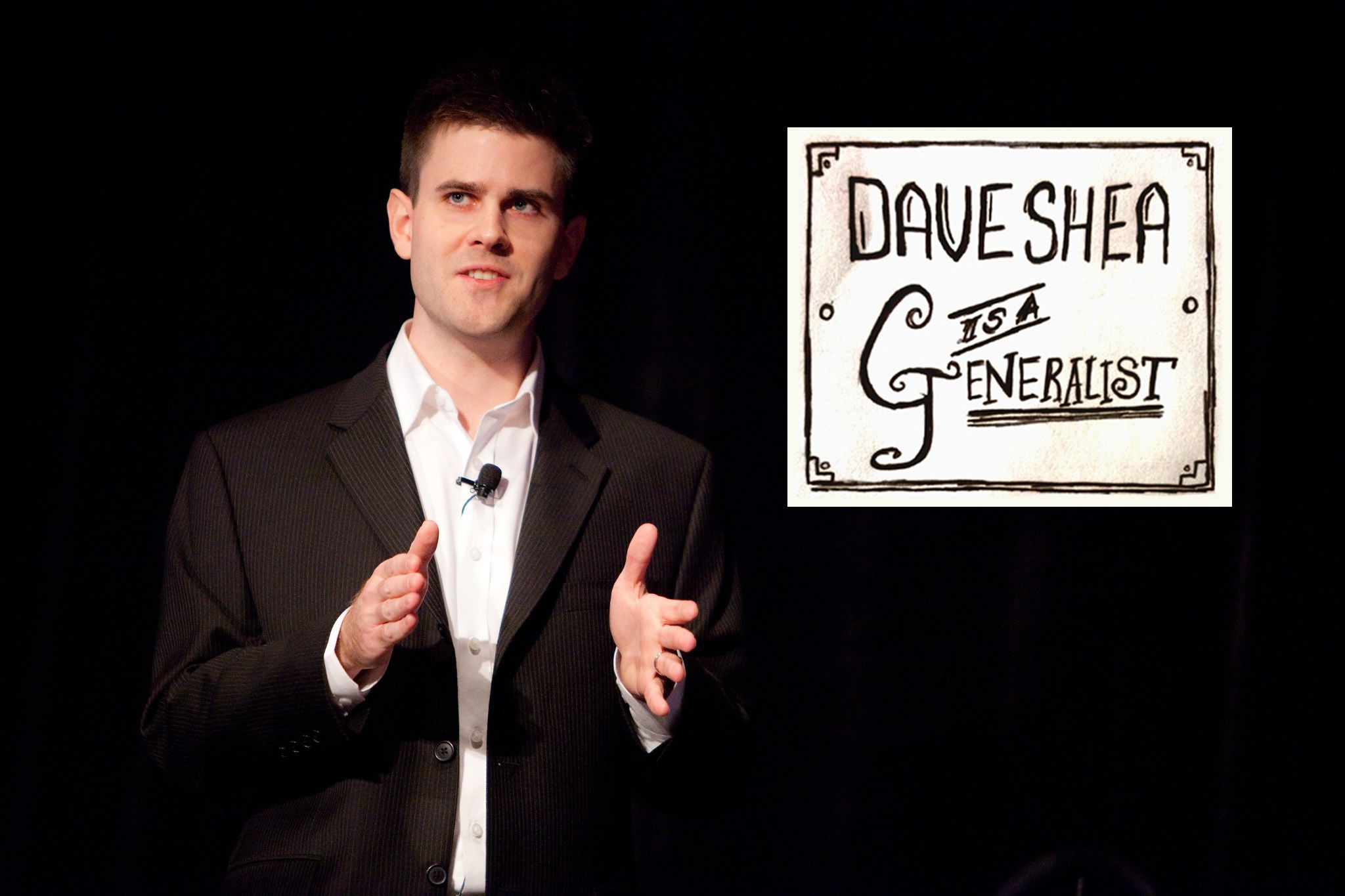
December 9, 2009 at An Event Apart in San Francisco, Dave Shea stood on stage and declared himself a generalist.
His words resonated with me. So much so that I sketched “Dave Shea is a generalist” in my journal and promised myself that if a design hero of mine could do it and find some success, I could make it work too.
I’ve always dreamed of a cross-discipline career. When I was a kid, I wanted to be a scientist and an artist. Leonardo da Vinci was my hero. The idea of combining design, engineering, science, history, psychology, gaming, art… there’s just so much fertile ground for insight and connection. I’ve just always found it so… interesting.
Of course, that perspective seems wildly at odds with the modern sensibility to specialize: “Dig deep, not wide!” And it’s not hard to see why that advice is common: many of our most significant technologies have come from people who niche down, solve focused problems, and build out successful careers on that specialized focus.
But as our technologies (and systems!) increase in complexity and interconnectedness, I believe there’s an increasing value in people who can stitch together disparate ideas from multiple disciplines, who can bridge gaps and see the big picture.
I recently chatted with Camden Asay, Manager of Design Systems at DoorDash. When I asked him about hiring for a design systems team, he suggested I prioritize hybrid roles as much as possible. UX engineers and design technologists are valuable because they can take whatever approach makes the most sense for a given project. They might create a visual prototype. They might build a prototype in code. They might create a simple flat-file reference site. They might create a Figma plugin. Whatever makes the most sense… it’s like Maslow’s Anti-hammer.
I like to think of generalists like hunter-gathers, foraging their way through various landscapes of learning. The pick up some key insights here, some salient frameworks there, a few key skills somewhere else… all the while connecting a wide range of disparate mental ideas together. They may not be not as focused as their farmer counterparts, but what they lack in efficiency, they make up for in synthesis and big-picture thinking.
I’m not saying we should abandon specialization altogether. We need people that understand technologies deeply, now more than ever. But we need environments filled with diverse thinking and cultures where generalists and specialists collaborate closely, creating a tapestry of ideas.
David Krakauer, president of the Santa Fe Institute, articulated my thoughts on this beautifully in describing the institute’s philosophy of knowledge work:
“Let’s certainly use the skills we’ve acquired in the disciplines, but let’s leave them at the door and just be intelligent about complex problem.”